What is positive vs normative economics?
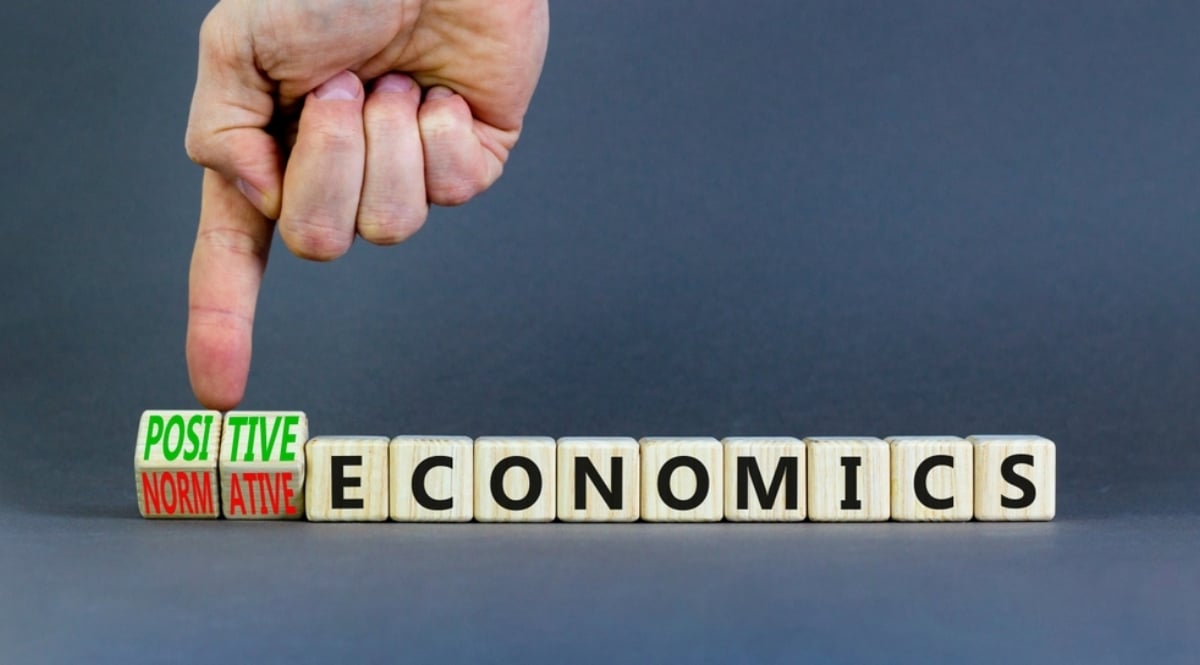
What is a positive vs. normative economics comparison?
Key Takeaways:
Positive economics explains economic events with data. Normative economics focuses on what’s fair for the economy. Positive economics relies on facts, not opinions, while normative economics uses subjective values. Public policy often combines both approaches.Have you recently thought about what positive vs normative economics is all about? Why is it essential to deeply understand each of these terms, plus their comparison by a skilled professional?
Sometimes, life and economics proceed as predicted when economic growth and interest rates suddenly alter. Two primary branches divide economics.
Positive economics describes actual economic events, while normative economics focuses on what should happen in fairness.
These branches are visible in the economy, especially when unexpected changes happen.
So, what do they mean exactly, and what do these economics include? How to compare them the best? Let’s get to know more about it, shall we?
Positive economics definition by a professional
Positive economics is the objective description, amount, and explanation of economic events and phenomena using data analysis.
Its primary aim is to uncover cause-and-effect relationships and assess economic theories through specific, measurable statements.
This approach excludes personal opinions. For instance, a positive economic approach involves analyzing the unemployment rate in regions with a higher minimum wage.
Contrastingly, Normative Economics
Normative economics entails making value judgments and addressing policy questions, such as whether increasing the minimum wage benefits society.
In contrast, positive economic statements provide objective descriptions of economic realities without incorporating subjective assessments.
Normative definition: explained by a PRO
Normative economics, a branch of economics, is crucial for making informed economic choices and comprehending various economic aspects.
It helps make plans and policies, like increasing the lowest pay and lessening the gap between rich and poor.
This field of economics focuses on determining what is fair and strives to create diverse economic scenarios. It aids in gaining insights into the functioning of the economy and formulating effective regulations.
What is essential to note here?
It helps make plans and policies, like increasing the lowest pay and lessening the gap between rich and poor.
Normative economics provides insights into fairness. However, economic decisions should also take into account facts and principles.
This is necessary for creating balanced and evidence-based policies. Normative economics advocates for raising the minimum wage for workers, driven by personal beliefs and societal objectives aimed at reducing income inequality.
When does normative economics come into play?
For instance, normative economics supports raising the minimum wage to help workers. Subjective values and social policy goals guide it.
Opposite to that, the assertion that higher minimum wages boost GDP falls within the domain of positive economics.
Normative vs Positive Economics – Compared by a PRO
Economics has two parts: positive and normative. Positive economics explains real economic stuff with facts and data.
Normative economics decides what’s fair and best for the economy, like suggesting a higher minimum wage to help workers. It uses personal values and society’s goals to understand economic things.
Differences and meaning of Positive vs Normative economics
Positive economics uses data and facts, while normative economics includes subjective statements without concrete data support.
Different Perspectives
Positive Economics: Takes an objective approach, providing precise statements rooted in factual data. Normative Economics: In contrast, introduces subjectivity by incorporating value judgments and ideals, offering a different perspective.Functions
Positive economics looks at how things cause other things in the economy using facts. Normative economics, on the other hand, focuses more on giving opinions and values, which is a different job.Areas of Study
Positive economics explores what’s really happening in economics using facts and numbers. Normative economics is about opinions and what people think should happen, not about the actual numbers.Testing
Positive Economics: Can scientifically test and validate statements through rigorous testing methods. Normative Economics: Relies on beliefs and opinions, not scientific testing. It’s not the sole basis for economic choices, requiring more objectivity and proof.Economical Explanation
Positive economics helps us understand economic issues by giving us clear and factual explanations. Normative economics, on the other hand, suggests solutions based on personal beliefs and viewpoints. However, it often needs more data and evidence to back up these ideas. Both of these branches of economics are important for studying economic phenomena.Positive Economics vs Normative Economics – More Info
Knowing the difference between positive and normative economics is important.
Positive economics explains real economic stuff using facts.
Normative economics thinks about what’s fair and good for the economy, like raising the minimum wage to help workers. But making good decisions needs more than just one idea. Both are parts of economics.
The basis for good or bad economic judgements
However, it can’t be the basis for judgments about what’s good or bad for an economy.
Positive economics is objective, analysing facts and the effects of decisions on society.
How does Positive Economics support lawmaking?
It helps legislators implement normative economic statements by providing factual support. It explains how government actions affect inflation and banking reforms using data and analysis, making economic relationships clearer.
Significance for Commerce Students and Economic Theory
Commerce students need to grasp this difference to deal with complex economic issues and understand economic theory effectively.
They can explore Vedantu’s official website to learn more about economics topics, especially those rooted in facts.
Pros and Cons of Positive vs Normative economics
Here are the main pros and cons of Positive vs Normative economics:
Pros of Normative Economics:
It helps leaders make good policies and deal with society’s problems. It wants to make life better for people and be fair. It makes people think creatively and find new ideas.Cons of Normative Economics:
It’s based on personal opinions, which can make things biased and cause different viewpoints. There isn’t enough solid data to tell if the proposed ideas will work well. It can’t be the only thing to make economic choices; we need more facts and proof.Pros of Positive Economics:
1. Provides clear facts about economic realities through data analysis. 2. Uses scientific testing to validate statements. 3. Helps policymakers make informed decisions with factual support.Cons of Positive Economics:
1. Only focuses on facts, may ignore ethical or value-based aspects. 2. Might not fully address complex economic and social issues that need normative thinking. 3. Risk of misinterpretation if data analysis or presentation is incorrect.Bottom line
Understanding the difference between positive and normative economics is crucial. Positive economics relies on facts and describes economic realities, while normative economics involves opinion-based ideals.
Both branches impact policies and judgments. Normative economics encourages new ideas but isn’t the sole basis for judgment.
The post What is positive vs normative economics? appeared first on FinanceBrokerage.