State-level AI rules survive — for now — as Senate sinks moratorium despite White House pressure
The Senate is quietly winning the battle over states’ abilities to craft their own artificial intelligence (AI) regulations, but there is still a desire to chart out a rough framework at the federal level.
The issue of a blanket AI moratorium, which would have halted states from crafting their own AI regulations, was thought to have been put to bed over the summer. But the push was again revived by House Republicans, who were considering dropping it into the annual National Defense Authorization Act.
However, Republicans in the lower chamber have pulled back from that push, even as the White House has pressed Congress to create a federal framework that would make regulations more cohesive across the country.
A trio of Senate Republicans, Sens. Josh Hawley of Missouri, Marsha Blackburn of Tennessee and Ron Johnson of Wisconsin, who banded together to block the original proposal, cheered the provision’s apparent rise from the grave.
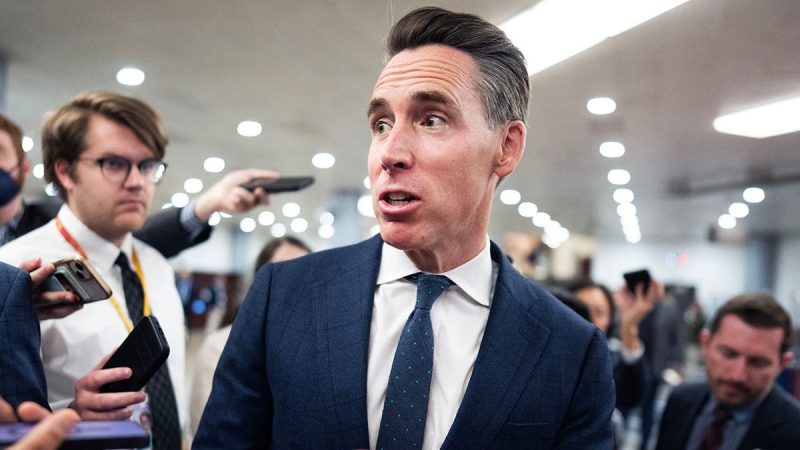
Hawley told Fox News Digital that it was good news that the provision would not be included in the defense authorization bill, but warned that ‘vigilance is needed, and Congress needs to act.’
‘I mean, for everybody out there saying, ‘Well, Congress needs to act and create one standard,’ I agree with that,’ he said. ‘And we can start by banning chat bots for minors.’
Sen. Ted Cruz, R-Texas, who chairs the Senate Commerce, Science and Transportation committee, initially pushed for a moratorium to be included in Trump’s One Big, Beautiful Bill. His position on the issue has been to unchain AI to give the U.S. a competitive edge against foreign adversaries like China.
But that attempt was nearly unanimously defeated over the summer and stripped from the bill. And Cruz hasn’t given up.
‘The discussions are ongoing, but it is the White House that is driving,’ Cruz told Fox News Digital.
Senate Majority Leader John Thune, R-S.D., acknowledged that getting the moratorium into the defense authorization bill would be difficult earlier in the week.
‘That’s controversial, as you know,’ Thune said. ‘So, I mean, I think the White House is working with senators and House members for that matter to try and come up with something that works but preserves states’ rights.’
Trump declared last month that the U.S. ‘MUST have one Federal Standard instead of a patchwork of 50 State Regulatory Regimes,’ and argued that over regulation at the state level was threatening the investment, and expected growth, of AI.
The White House reportedly drafted an executive order that would have blocked states from regulating AI that would have withheld certain streams of federal funding from states that didn’t comply with the order, and enlisted the Department of Justice to sue states that crafted their own regulations.
So far, Trump has not taken action on the order.
Blackburn, who was the leading player in thwarting Cruz’s previous attempt to assert an AI moratorium into Trump’s marquee tax bill, also wants some kind of federal framework, but one that is designed to ‘protect children, consumers, creators, and conservatives,’ a spokesperson for Blackburn told Fox News Digital in a statement.
‘Senator Blackburn will continue her decade-long effort to work with her colleagues in both the House and Senate to pass federal standards to govern the virtual space and rein in Big Tech companies who are preying on children to turn a profit,’ the spokesperson said.
And Johnson, another key figure in blocking the moratorium earlier this year, argued to Fox News Digital that it was an ‘enormously complex problem. It’s my definition of a problem.’
But unlike his counterparts, he was more skeptical about Congress producing a framework that he would be comfortable with.
‘I’m not a real fan of this place,’ Johnson said. ‘And I think we’d be far better off if we passed a lot fewer laws. I’m not sure how often we get it right. Look at healthcare, look at how that’s been completely botched.’
‘What are we gonna do with AI? Hard to say, but we just don’t go through the problem-solving process,’ he continued. ‘And again, I’m concerned, the real experts on this have got vested interests. Whatever they’re advising is, can you really trust them?’