$5,000 Ethereum Price Looks Unlikely This Cycle, Experts Say
Key Takeaways:
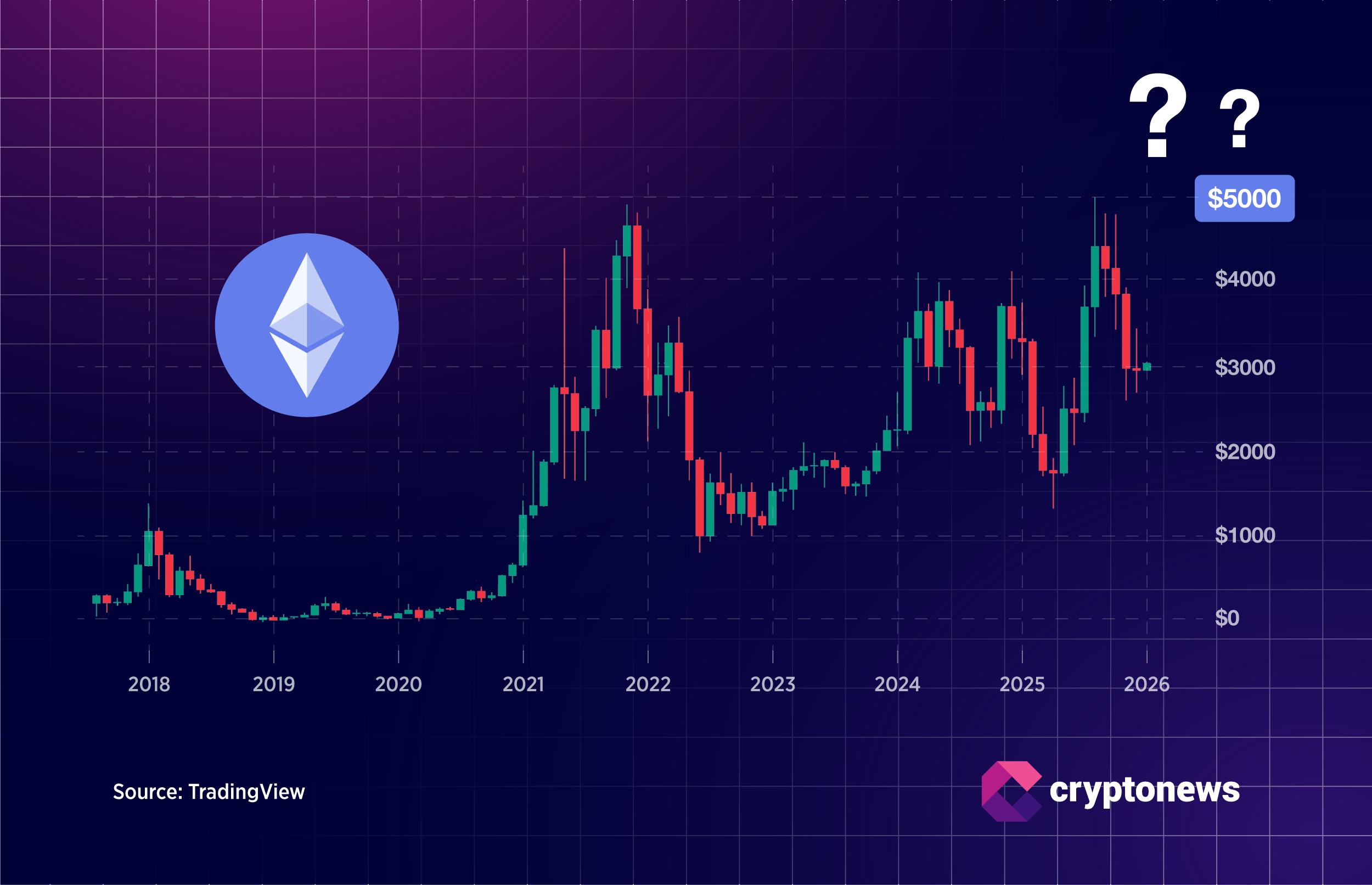
Ethereum remains well below its all-time high, and most experts see a move above $5,000 as unlikely in the current cycle without a clear alignment of catalysts. Despite strong adoption and infrastructure dominance, Ethereum continues to struggle with value capture, creating a disconnect between network usage and token performance. Some experts still see a bullish scenario for 2026, driven by protocol upgrades such as Fusaka and Glamsterdam, although governance and funding risks remain. The broader altcoin market continues to follow Ethereum’s direction, with limited momentum and few large-scale breakouts. Investor behavior has become more selective, with capital rotating into individual narratives rather than the market as a whole. Privacy-focused coins like Zcash and Monero have outperformed, while many anticipated narratives, including new Layer 1s, remain absent. Solana reflects similar market pressures, with declining usage and TVL, but continues to hold strong positions in key niches such as DEXs and meme coins. Overall sentiment remains cautious, suggesting the market is still stabilizing after the recent sell-off rather than entering a new expansion phase.Ethereum (ETH) reached its all-time high at $4,953 on Aug. 24, 2025. This was the moment when the coin set its ATH. In a way, it can be called slightly ironic, because Ethereum missed the $5,000 level by just $7.
Ethereum price continues to trade above $2,500. This is still below the all-time high, but in some ways, there is good news in this. ETH has not returned to its lows from last year. In April 2025, Ethereum’s price dropped below $1,500. After that, the price started to recover and move higher.
Since then, Ethereum has remained relatively resilient compared to previous drawdowns. However, the recovery has been uneven, and price action has lacked a clear trend. This has kept both investors and analysts cautious, even as the broader network continues to develop.
This raises a natural question. Does Ethereum still have a chance to return to these levels in 2026? And can the price move above $5,000? In this report, Cryptonews spoke with experts about the current situation around Ethereum. Their opinions differ.
Gavin Thomas, CEO of Obscuro Labs, told Cryptonews that he sees a scenario in which Ethereum’s price trades above $5,000 as unlikely. He notes that this could still happen, but many pieces would need to fall into place for that to occur:
Ethereum is unlikely to be trading above $5,000 this cycle. It’s possible, but it would require a very clean alignment of catalysts: ETF inflows that persist beyond the launch window, clarity around staking within those products, and visible evidence that rollup activity is translating into durable value capture.
‘We Risk Becoming a Successful Network With a Stagnant Token’
One of the paradoxes around Ethereum in recent years is that the price of the coin does not reflect the importance of the blockchain itself.
It often feels unnecessary to prove that Ethereum remains the king of infrastructure. Over the years, the network has absorbed and outlasted enough so-called “Ethereum killers” to demonstrate that position. However, despite continued development and growth across the ecosystem, Ethereum price has only updated its all-time high once in several years.
Continuing his thoughts on price and the difficulty of reaching $5,000, Thomas points out that investors may still be underestimating what is happening around Ethereum:
One important tailwind, and one the market is still underpricing, is that Ethereum is increasingly viewed as the default settlement layer for institutional finance, particularly in Europe. It’s widely considered the leading candidate for tokenised financial infrastructure and even for components of a future digital euro. Real usage like this has been a long time coming and is the holy grail of blockchain technology which would directly translate to future dominance of ETH.
Eneko Knorr, co-founder and CEO of Stabolut, told Cryptonews that a price above $5,000 for Ethereum is “inevitable.” At the same time, he points to issues around revenue and the weak price performance of the token. This, in his view, could lead to a situation where Ethereum succeeds as a blockchain but not as a crypto asset:
The real story here is a paradox: Ethereum is winning on adoption but it’s cannibalizing its own revenue to do it. We’ve built a superhighway that is jam-packed with traffic, but the toll booth is practically charging nothing. We are building a public utility that everyone uses, but if we don’t fix the value capture, we risk becoming a successful network with a stagnant token.
Is a Bullish Scenario for Ethereum Price Still Possible in 2026?
Not all experts believe that Ethereum is done in this cycle. There are also opinions that the cycle has shifted and that the crypto market could recover during Q1–Q2.
Jesus Perez, CEO of Posidonia 21 Capital Partners, told Cryptonews that a move to $5,000 is possible. While the Fusaka upgrade could lead to a decline in fee revenue, Perez sees this as a long-term trade-off:
Our base-case scenario is that Ethereum trades above $5,000 during 2026. The main positive triggers are the Fusaka and Glamsterdam upgrades, which significantly expand Ethereum’s transactional capacity. While these improvements may reduce fee revenue in the short term, they are strategically important.
Perez continues:
They reposition Ethereum as a highly competitive low-fee environment, encouraging more activity to take place directly on Layer 1. Over time, higher transaction volumes should translate into greater aggregate demand for Ethereum.
However, one of the key factors for a bearish scenario, Perez says, is the Ethereum Foundation. Not long ago, disagreements between the Ethereum Foundation and Vitalik Buterin were actively discussed. There was even talk on X that the project might need new leadership.
Perez believes that the organization could lose its financial sustainability, which could eventually affect the protocol itself:
Although market pressure has prompted some internal changes within the Ethereum Foundation, there is still no explicit long-term plan to ensure sustainable protocol-level revenues. A material risk is that the Foundation eventually depletes its financial reserves without a clear mechanism to fund ongoing development. Relying on donations in the future would be an extremely fragile model for a protocol of Ethereum’s systemic importance.
Eneko Knorr also emphasizes that the main risk for Ethereum does not come from competitors like Solana or other networks. Instead, the risk lies in Ethereum’s own structure, particularly in the economics of Layer 2 solutions. Addressing these issues could give Ethereum’s token new momentum and restore investor confidence:
The bearish trigger I’m watching isn’t a competitor; it’s inside the house. If major Layer 2s stop ‘paying rent’ and move their data off-chain to save money, Ethereum’s revenue evaporates. That scenario could easily drag prices back to the $1,500 range. We need to prove ETH is a sovereign asset that captures the value flowing through it, not just a cheap utility for others to build on.
Altcoin Market: Fewer Breakouts, More Selectivity
After Ethereum, it makes sense to look at Solana (SOL) and the broader altcoin market. Overall, the trend remains the same. Most altcoins continue to follow Ethereum’s lead. When ETH struggles, the rest of the market tends to struggle as well. At the same time, there are still isolated breakouts.
Right now, investors behave less like broad market buyers and more like snipers. Instead of chasing the entire altcoin market, they are trying to spot individual “gems” while the broader market remains under pressure.
December has not delivered impressive numbers. Large-scale rallies are still missing. Among the top performers, privacy-focused coins stand out once again, including Zcash (ZEC) and Monero (XMR). Zcash, in particular, has remained among the top performers for the third month in a row.
Alongside these, the list also includes newer projects and meme coins. What is notably absent, however, are some of the most anticipated narratives. Monad (MON), the highly anticipated Layer 1, does not appear among the leaders. Neither do tokens from the Ethereum ecosystem.
For now, the altcoin market appears to be in a recovery phase after the recent sell-off. Momentum remains fragile, and conviction is limited. Against this backdrop, some experts argue that investors may be focusing on the wrong signals.
Dr. Leo Fan, co-founder of Cysic, told Cryptonews that the market has misread the drivers behind recent price action:
Investors misjudged the market’s sensitivity to global macroeconomic factors, as crypto no longer operates outside traditional liquidity and interest rate cycles. Furthermore, sectors such as DePIN are often overlooked by investors. In 2025, we’ve seen the impact of infrastructure failures, such as the Cloudflare outage, and upgrade delays, such as the delay of Pectra earlier this year. In 2026, investors should look closer at the DePIN sector, recognising its potential to make an impact in the broader crypto market.
According to Fan, the next phase of growth is unlikely to come from short-term speculation alone. Instead, he believes durable performance will be tied to real infrastructure and verifiable systems:
The most durable growth in 2026 will be found at the intersection of verifiable AI and DePIN, driven by the fundamental need for trust. The critical signal is when the market shifts from pure speculative hype to creating utility from services like ZK networks and auditable decentralised GPU networks. Technologies like ZK that guarantee verifiability and efficiency will be best positioned to capture enterprise and institutional value.
One of Ethereum’s main competitors, Solana, appears to be going through a similar phase.
Overall market sentiment has turned more pessimistic, and this is reflected in several key metrics. User activity has declined. Total value locked (TVL) is also down. In that sense, Solana is not an exception.
At the same time, the ecosystem remains one of the strongest in the market. Solana continues to occupy clear niches, including DEXs, meme coins, and other high-activity segments. Development has not stopped, even as broader conditions remain challenging.
The token itself, however, is still moving in line with overall market sentiment. SOL has been under pressure, although it remains above the $100 level and continues to hold it for now.
Matas Čepulis, Founder and CEO of LuvKaizen, told Cryptonews that the bearish narrative around Solana only captures part of what is happening:
Market sentiment is bearish right now. Most experts will tell you the same thing: users are down, usage is down, TVL is down and they’re not wrong. But that’s only half the picture, because Solana is still one of the top chains by TVL. One of the biggest in total protocols built, and it’s leading DEX volume. Yes, we’re in a downswing, that’s obvious. But the idea that Solana could collapse is just not real. Superteam is doing serious work by onboarding builders and bringing in new people who are shipping real projects into the ecosystem.
Conclusion
Taken together, expert views suggest that Ethereum’s path to $5,000 remains uncertain. The network continues to strengthen its position as core infrastructure, but questions around value capture, revenue, and governance still weigh on the token.
The broader altcoin market reflects a similar mood. Momentum is limited, risk appetite is selective, and investors are increasingly focused on specific narratives rather than broad rallies. Solana’s situation mirrors this pattern, with a strong ecosystem but a token still pressured by overall market sentiment.
For now, the market appears to be in a pause rather than a reset. Whether 2026 brings a renewed cycle or a slower rebuilding phase will likely depend less on hype and more on fundamentals finally translating into sustained value.
Key Crypto & Macro Events to Watch in January 2026
January 5
• S&P Global Services PMI (December) – USD
• ISM Manufacturing PMI (December) – USD
• ISM Manufacturing Prices Index (December) – USD
January 7
• Eurozone CPI (YoY) (December) – EUR
• ADP Nonfarm Employment Change (December) – USD
• ISM Non-Manufacturing PMI (December) – USD
• ISM Non-Manufacturing Prices Index (December) – USD
• JOLTS Job Openings (November) – USD
January 9
• Average Hourly Earnings (MoM) (December) – USD
• Nonfarm Payrolls (December) – USD
• US Unemployment Rate (December) – USD
Disclaimer: Crypto is a high-risk asset class. This article is provided for informational purposes and does not constitute investment advice.
The post $5,000 Ethereum Price Looks Unlikely This Cycle, Experts Say appeared first on Cryptonews.